Large Print Activity Books for Seniors: What Actually Makes One Worth Buying
Not every large print activity book for seniors is worth it. Here's what a longtime caregiver looks for before she buys one.
I have been working as a homecare worker for 15 years. The majority of my time has been spent providing homecare services; however, I also worked in assisted living facilities for approximately three years prior. If there was something I purchased more times than I could possibly recall, it would be activity books. I purchased these activity books for my clients. I also purchased them for my own mother during her final years of life. Honestly, by the end of 5-10 years of purchasing activity books, I found myself enjoying some of the better ones too.
When you are looking at an assortment of activity books (often large print) for your senior loved one — whether it be in the aisle of a store, or more commonly browsing online at 11pm when everyone is finally asleep, and you are trying to determine which “large print activity book for seniors” will actually receive use — I hope you can see why someone who has purchased many of the wrong activity books wants to give you their perspective. I’ve lost count how many incorrect activity books I have purchased. I even have a shelf in my garage that is essentially a graveyard for good ideas.
Activity books with cracked covers due to being forced open, activity books that were only looked at once and then discarded, activity books that made the individual I purchased them for feel belittled, and therefore embarrassed, by the purchase.
As you may be able to understand, if you have witnessed the expression on someone’s face when they have felt embarrassed, you probably realize that the embarrassment associated with feeling belittled by having received an activity book is much worse than if the individual had simply left it closed.
So let me save you some money and some disappointment. Here’s what I actually look for now.
Start with the print. Really look at it.
This sounds obvious, and that’s exactly why people skip it. “Large print” gets stamped on covers the way “homemade” gets stamped on jars of sauce — sometimes it means something, sometimes it’s just what sells.
Here’s my rule: if I have to hold the sample page at arm’s length and squint to read the small print description that says how big the print is, that’s a bad sign. I’m looking for real size — think somewhere around 18 to 20 point, generous space between the lines, enough margin that the page doesn’t feel crowded. My father-in-law used to say a book either welcomed him in or made him work for it before he’d even started. He wasn’t wrong.
If the listing has sample pages, actually look at them. Don’t take the cover’s word for it.
Does the difficulty go anywhere, or is it flat the whole way through?
I learned this one the hard way. I bought a puzzle book for a client of mine — sharp woman, used to run her own bookkeeping business, no patience for anything that felt beneath her — and every single page was exactly the same level of easy. She got through about ten pages and told me, very politely, that she felt like she was being handed the same worksheet over and over. She wasn’t wrong either.
A book that’s worth its price usually builds a little as it goes. Something to ease into, and then something further in that actually makes you sit and think for a second. That’s not just good design — it’s what keeps a person coming back to the next page instead of setting the book down for good.
Whatever you do, don’t buy anything that talks down to them
This is the one I feel most strongly about, so bear with me.
I’ve picked up activity books that use this singsong, oversimplified tone — like the person reading it is a kindergartner, not a grown adult who’s lived seventy, eighty, ninety years and raised children and run businesses and buried people they loved and built entire lives before you or I came along. That tone gets noticed. Every single time. And once someone feels like a book is speaking down to them, they’re done with it — not because the puzzles were too easy, but because the whole thing felt like an insult dressed up as a gift.
The seniors I’ve worked with over the years want to be challenged. They want something that respects the fact that they’re a full, capable adult — not a project, not a patient, just a person who’d like something engaging to do with their afternoon. When you’re looking at a book, read a page or two of the actual instructions, not just the puzzles. If the tone feels like it’s written for a child, put it back.
It actually has to be enjoyable — not just “good for them”
I want to be honest about something. Early on, I used to pick activity books the way you’d pick a vitamin — this is good for the brain, so it must be worth buying, end of story. And I’d bring these very earnest, very dry books to my clients and watch them do exactly one page before setting it aside forever.
What I’ve learned since is that enjoyment isn’t the icing on top. It’s the entire mechanism. A book someone actually looks forward to — word searches with a bit of personality to them, trivia that makes someone laugh or say “oh, I remember that,” puzzles that feel like a satisfying workout for the mind rather than a task on a list — that’s the book that gets picked up again the next day, and the day after. If it feels like homework, it goes in the drawer. I’ve seen this play out more times than I can count.
Check how the thing actually opens
I know this sounds small, but hear me out. There is nothing more frustrating than trying to fill in a crossword while wrestling a book that keeps snapping shut on you. I’ve watched clients get genuinely annoyed — not at the puzzle, but at the book itself, fighting to keep it open with one hand while trying to write with the other.
Spiral binding is usually your safest bet. If it’s a paperback, check whether reviewers mention it lying flat, especially toward the middle pages. This is the kind of detail nobody thinks about until they’re the one holding the book open with their elbow.
Some variety goes a long way
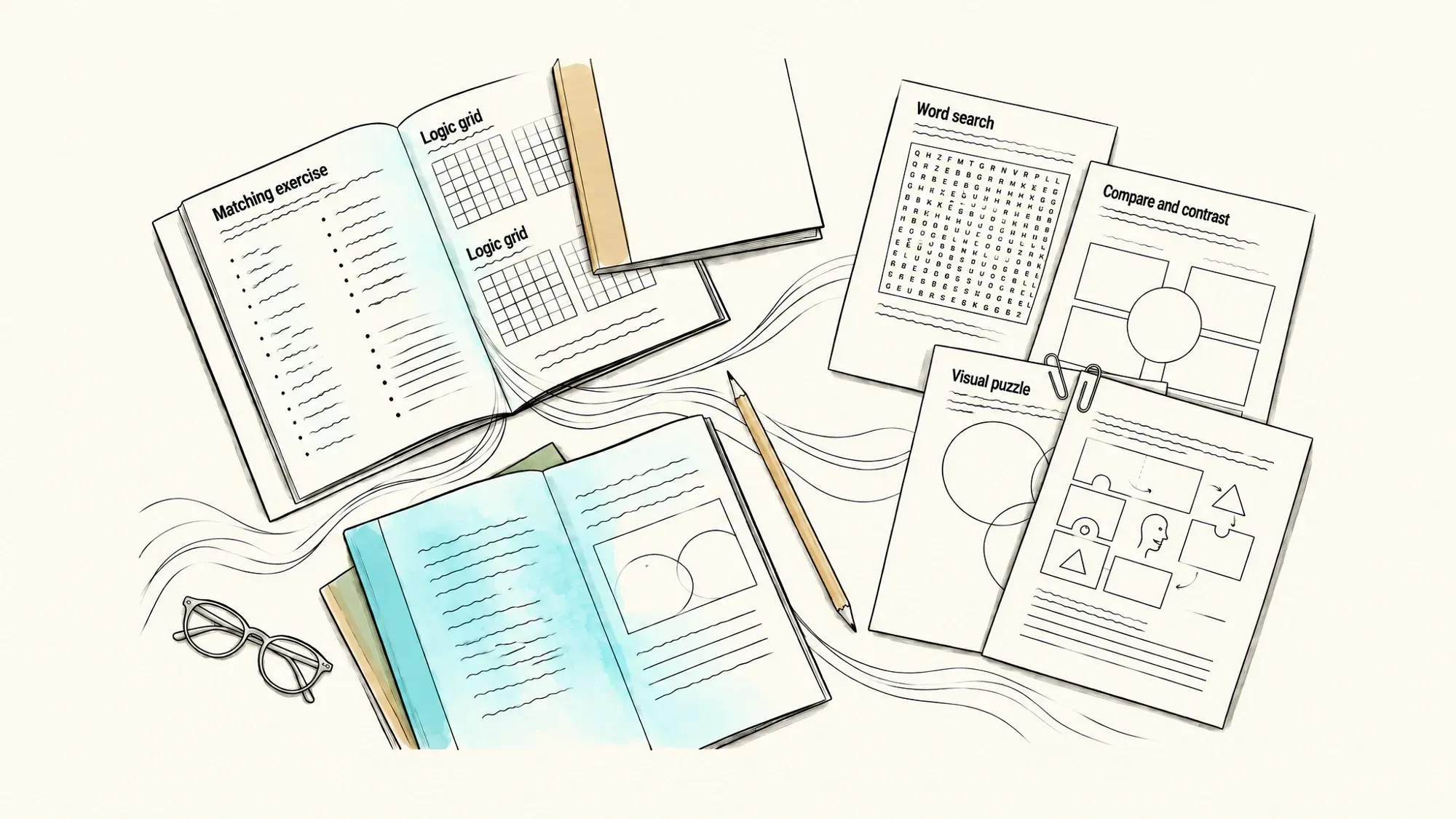
The best activity books I’ve come across mix it up — a bit of word search, some trivia, a memory-jogging prompt here and there, maybe a lighter puzzle mixed in with something trickier. That way, whatever mood someone’s in that day, there’s something in the book that fits it.
Now, if someone you’re buying for has a genuine favorite — my mother, God rest her, was a sudoku woman through and through, no interest in anything else — then a single-format book is completely fine. Lean into what they already love. But if you’re not sure yet, or you’re buying for someone whose tastes you’re still learning, variety tends to keep a book in play a lot longer than a single repeated format does.
Here’s the real test I use
Before I buy anything now, I ask myself one simple question: can I actually picture this person sitting down with it, pencil in hand, wanting to know what’s on the next page? Not because a doctor told them it’s good for them. Not because their daughter feels better knowing they’re “doing something.” But because it’s genuinely something they want to spend twenty minutes with.
That’s the whole test. Everything else — the print size, the pacing, the tone, the binding — is really just in service of that one thing.
Where to start
If you’re standing where I’ve stood more times than I can count — trying to pick the right book for someone you love, hoping this is the one that actually gets used — that’s exactly what The Memory Games Collection was built for. Real large print, activities that build as you go, and a tone that never once talks down to the person holding the pencil. If you want to see what a book that actually gets finished looks like, take a look at the collection here.