Assisted Living Activity Ideas: What Families Can Bring That Actually Makes a Difference
What does the research really say about assisted living activity ideas? A data-backed look at what families can bring that actually helps.
In 1991, a young doctor named Bill Thomas took a job as medical director of a nursing home in upstate New York. He’d been trained to treat the body. What he found, walking the halls of Chase Memorial, was something his medical training hadn’t prepared him for at all: a building full of people who were, by every clinical measure, “cared for,” and who seemed to be quietly disappearing anyway.
Thomas later put a name to what he was seeing. He called them the three plagues of long-term care: loneliness, helplessness, and boredom. Not diseases. Not conditions. Just the accumulated weight of days with nothing in them, in a place designed, with good intentions, mostly around safety and schedules rather than around a life worth living.
More than three decades later, with roughly a million Americans now living in assisted living communities nationwide, according to the National Center for Assisted Living, that diagnosis still holds up disturbingly well. And it raises a question I’d bet you’ve asked yourself, probably standing in a parking lot after a visit, keys in hand, wondering if the hour you just spent actually did any good: what actually helps?
Not what feels like it should help. Not what the gift shop sells. What genuinely makes a difference in how someone experiences their days.
So I spent the last several weeks going through the research myself — peer-reviewed studies, clinical trials, long-term care policy reports — to try to answer that as honestly as I could. Some of it confirmed what caregivers have suspected all along. Some of it surprised me, and honestly went against a few things I assumed were settled. Here’s what I found.
The scale of the problem is bigger than most families realize
Start with the numbers, because they’re worth sitting with for a moment. A systematic review published in the journal Ageing Research Reviews estimated that roughly 61% of residents in residential and nursing care homes experience moderate loneliness, and about 35% experience severe loneliness — with individual studies in the review reporting rates as high as 81% depending on the population and setting. A separate 2025 analysis using Health and Retirement Study data found that 37.7% of nursing home residents reported feeling lonely, and that loneliness was strongly correlated with depressive symptoms.
In other words, this isn’t a fringe issue affecting a small, unlucky subset of residents. It’s closer to the norm — which is a hard thing to sit with if you have someone you love living in one of these communities right now.
The Minnesota Assisted Living Report Card project puts a finer point on it. It’s one of the largest ongoing efforts in the country to systematically measure resident quality of life, drawing on responses from more than 12,000 residents across Minnesota facilities, and it found something quietly telling once the researchers broke satisfaction down by category. Residents rated their environment, their finances, and their sense of security relatively high. But “engagement” was one of the lowest-scoring domains in the entire survey, right alongside food and overall satisfaction. Families, for their part, said having their loved one’s personal needs met was also among the lowest-rated categories on their side of the same survey.
So here’s the pattern that keeps showing up: the physical care, on the whole, tends to be reasonably solid. It’s the part where someone feels like a full person with a day worth having that keeps falling short. That’s exactly the gap where family involvement seems to matter most — and exactly where the research gets specific about what kind of involvement actually closes it.
What the research says about family visits themselves
The most consistent finding across the literature is almost embarrassingly simple: family visits help, and their absence is measurably costly.
A cross-sectional study of 396 residents across shared-housing dementia care arrangements in Germany, published in BMC Geriatrics, found that active participation from family members was associated with meaningfully better quality of life, specifically in the domains of social relationships and reduced social isolation — a difference that held up under statistical controls. A broader review of assisted living research in the Gerontologist similarly concluded that family visits and involvement in care are associated with reduced depressive symptoms and improved quality of life among residents.
The starkest data point I came across, though, comes from Ontario, Canada, where researchers tracked all-cause mortality in long-term care residents during the early COVID-19 pandemic — a period when many facilities restricted family visits entirely. Residents who had no personal contact with family or friends during that window experienced 35% greater excess mortality than residents who maintained contact. Sit with that for a second. That’s not a quality-of-life statistic. That’s a survival statistic.
So the baseline finding really isn’t complicated: showing up matters, on its own, regardless of what you do once you’re there. But the more useful question — the one I actually wanted an answer to — is what happens during the visit. And that’s where the research got genuinely surprising.
The activities that sound helpful but haven’t held up
Here’s where I have to complicate things a little. I went into this expecting a tidy list of “activities that work.” What I found instead was messier — and I think it’s worth reporting honestly rather than smoothing over.
Group singing and general group music therapy are staples of activity calendars in nearly every assisted living community in the country. It’s an easy, low-cost, crowd-pleasing activity, and it’s been assumed for years to reliably lift mood in residents with dementia. But the MIDDEL trial — a large, cross-national, randomized controlled trial published across multiple countries including the UK, involving 192 residents with dementia across 16 care home units — found that neither group music therapy nor recreational choir singing produced a statistically significant improvement in depressive symptoms after six months. The choir singing arm actually showed some unfavorable effects on mood and behavioral symptoms compared to usual care.
Similarly, a randomized controlled crossover trial of the widely adopted Music & Memory program — the nonprofit initiative that supplies residents with personalized music playlists on individual devices — found that while trends favored the intervention, the differences in agitation, behavioral symptoms, and medication use did not reach statistical significance across 59 residents in 10 nursing homes over 14 weeks. The researchers noted that inconsistent implementation by facility staff may have been part of the problem — a detail that matters enormously for what families should take away from this, and one I’ll come back to.
I don’t think this means music or group activity is worthless — that would be reading it wrong. What it seems to mean is that generic, one-size-fits-all, passively delivered activity, the kind a busy staff can schedule for an entire floor at once with little individual customization, consistently underperforms something much more specific. And that something is where things get hopeful again.
What the research says actually works: personalization, not programming
If there’s a single finding that emerges most clearly and most consistently across this body of research, it’s this: individualized, personally meaningful engagement outperforms generic activity, often by a wide margin — and family members are usually the only people with the information required to make an activity personal.
The strongest evidence for this comes, again, from music — but personalized music, not group sessions. A retrospective study out of UC Davis’s Betty Irene Moore School of Nursing, tracking 4,107 residents across 265 California nursing homes over three years, found that residents enrolled in personalized Music & Memory programs — playlists built around their own specific, individually chosen music history — saw antipsychotic medication use decline by 13% per quarter, anti-anxiety medication use decline by 17% per quarter, reported pain decrease by 17% per quarter, and aggressive behaviors drop by 20%. A separate evaluation from New York City Health + Hospitals, following 108 residents across memory care units over two years, found significant reductions in transfers to psychiatric emergency departments and reductions in falls and physical altercations after implementing personalized playlists.
The gap between that result and the null result from the smaller randomized trial mentioned above isn’t really a contradiction — it’s a clue. The common thread in the studies that found strong effects was individualization done well: real family input into what music actually mattered to that specific person, not a generic “greatest hits of the resident’s generation” playlist assembled by an overworked activities coordinator with twenty other residents to get through that afternoon.
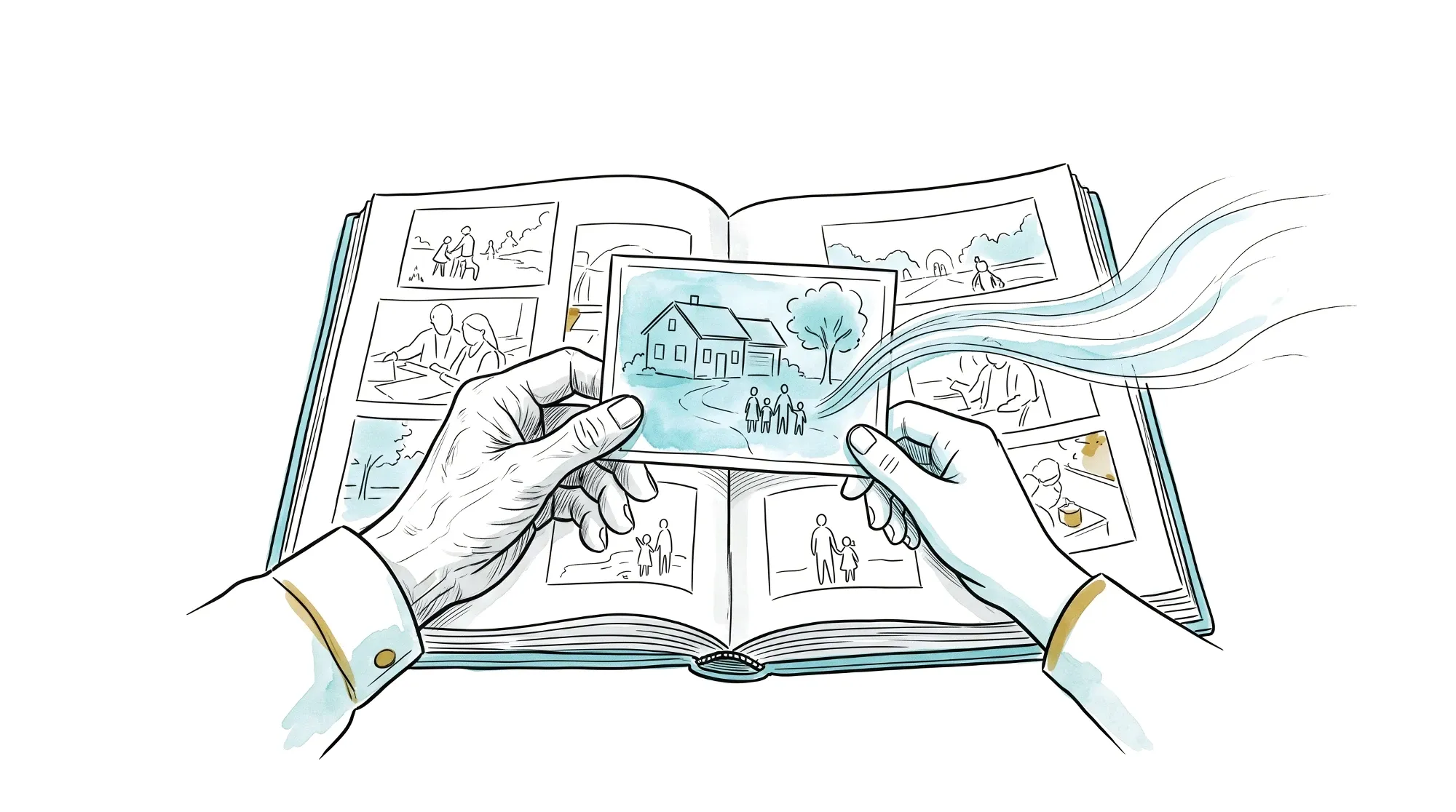
The same pattern shows up with personal objects. Multiple studies on what’s often called “memory box” work — curated collections of a resident’s own photographs, mementos, and sensory objects from their own life — describe consistent reductions in anxiety and agitation, particularly useful during moments of confusion or distress. A peer-reviewed pilot study on a personalized multimedia system that displayed family photos and played favorite music selected specifically by relatives found overwhelmingly positive reports from residents, family members, and nursing staff alike, in an eight-week randomized crossover trial against a standard-attention control condition.
None of this takes special training. It just takes specific knowledge of one particular person’s life — the kind of thing you already carry around in your head without thinking of it as data, and the kind of thing a staff member managing dozens of residents simply has no way to know unless someone hands it to them.
What this actually means for what you bring on your next visit
This is usually where advice columns turn generic and vague. I’d rather not do that here, because the data itself is specific enough to let us be specific too.
Bring your own photographs and objects, not generic ones. The research on memory-box-style engagement is consistent: it’s not photographs in general that help, it’s their photographs — their wedding, their old job, their children as children, a specific place they lived. A stack of unlabeled stock photos of “the 1960s” doesn’t produce the same effect as their actual 1960s. If you have old photo albums sitting in a closet at home, that closet is more useful to your visits than almost anything you could buy.
Build a music list from their actual history, not their generation’s greatest hits. The strongest results came from playlists built around individual preference, not decade-appropriate assumptions. Ask specific questions before you build one: What did they dance to at their wedding? What was playing in the house on Sunday mornings? What did they sing along to badly and happily in the car? That’s a more useful research question than “what was popular in 1965.”
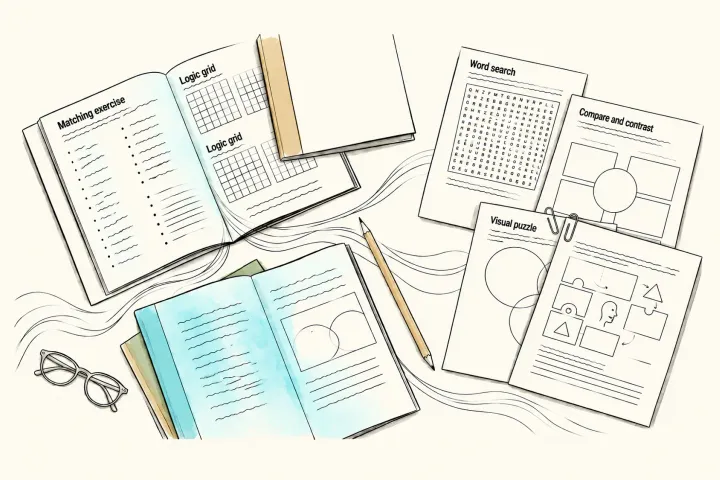
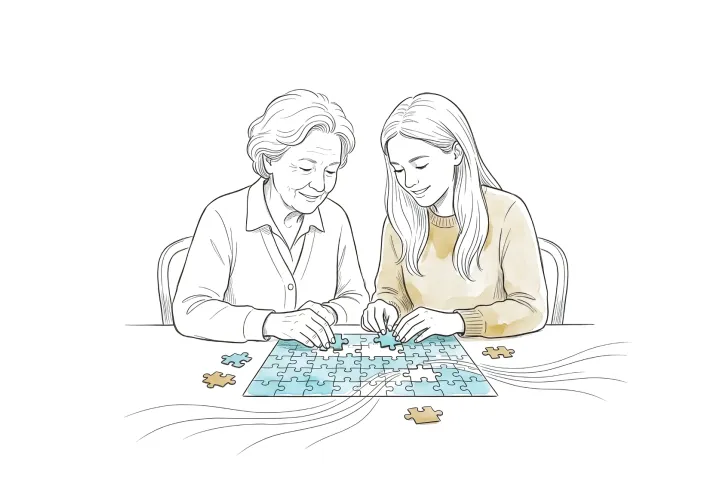
Choose activities with an actual arc, not passive consumption. Nearly every study that found strong results involved active engagement — physically handling an object, actively choosing music, working through something with a beginning, middle, and end — rather than passive activities done to or around the resident. This is part of why a shared activity like a puzzle or a word search tends to outperform simply sitting together in front of a television: it gives the visit an actual shape, a shared task, and something to talk about besides the effort of finding something to talk about.
Show up regularly, even briefly, rather than rarely for a long stretch. The mortality data from Ontario and the quality-of-life data from Germany both point toward consistency of contact, not the length of any individual visit, as the more powerful variable. A fifteen-minute visit every week has more research behind it than an occasional three-hour marathon visit meant to make up for lost time.
Advocate specifically, not generally, with staff. Because facility-level “engagement” scores are consistently among the lowest-rated domains in resident satisfaction research, and because implementation quality appears to determine whether personalized interventions actually work, the single most useful thing many families can do is hand staff the specific information they’re missing — write down the music list, the biography notes, the preferred activities — rather than assuming staff already has the bandwidth or the information to personalize care on their own initiative.
The honest bottom line
I didn’t find a single gift, gadget, or generic “senior activity” that reliably fixes the loneliness, helplessness, and boredom Bill Thomas identified more than thirty years ago. What I found instead, over and over, across completely different research teams, methods, and countries, was something less flashy and a lot more achievable: specific, personal, actively engaged time, built around who this particular person actually is, not who their age group is assumed to be.
That’s good news, if you think about it. It means the thing that works most reliably isn’t expensive, and it isn’t something only a facility can provide. It’s something only you actually can.
That’s also, not coincidentally, the entire design principle behind the activity books in our Memory Games Collection — built to be done together, actively, with real large print and content that respects the person doing it rather than talking down to them. If you’re looking for something to bring on your next visit that gives the time together an actual shape, take a look at the collection here.
Sources
- Dr. Bill Thomas and the “three plagues” of long-term care, Eden Alternative — McKnight’s Senior Living
- U.S. assisted living population figures, National Center for Assisted Living data — Caring.com
- Gardiner et al., systematic review and meta-analysis on loneliness in residential and nursing care homes, Ageing Research Reviews — ScienceDirect
- Smith & Theeke, loneliness among nursing home residents, Health and Retirement Study Wave 15 (2025) — PMC
- Minnesota Assisted Living Report Card project, resident and family satisfaction domains — PMC and PubMed
- Gräske et al., family visits and quality of life in shared-housing dementia care, BMC Geriatrics (2015) — PMC
- “Families and assisted living,” literature review, The Gerontologist — PubMed
- Ontario long-term care mortality and family contact during COVID-19 — California Department of Aging policy brief
- MIDDEL UK trial, group music therapy and choir singing for depression in dementia care homes — PMC
- Randomized controlled crossover trial of the Music & Memory program — PubMed
- UC Davis retrospective study of personalized music and medication use across 265 California nursing homes — Music & Memory
- New York City Health + Hospitals evaluation of personalized music in memory care units — Music & Memory
- Pilot study of a personalized multimedia “Memory Box” device for agitation and mood in dementia — ScienceDirect