Gifts for Elderly Parents Who Have Everything: 14 Ideas That Actually Get Used
Stuck on gifts for elderly parents who have everything? Research-backed ideas — built around time and connection, not more stuff — that actually get used.
You’ve been there before: standing in a store, or scrolling online at midnight, trying to think of something — anything — your parent doesn’t already have. They’ve downsized once, maybe twice. They tell you not to bother, that they don’t need a thing. And every gift-giving occasion turns into the same quiet dread: what do you get someone who has spent decades accumulating everything they need, and is now actively trying to have less of it?
I’ve sat with a lot of families over the years who are wrestling with exactly this. And I’ve watched the well-meaning gift go straight into a closet more times than I can count — not because anyone did anything wrong, but because the gift itself was never really the problem to begin with.
Here’s something that might take the pressure off: the research on gift-giving suggests this isn’t a failure of imagination on your part. A U.S. study by Finder.com found that Americans spend an estimated $13 billion a year on gifts that go unused, with 56% of people saying they’ll receive at least one gift they didn’t actually want. That’s not a small miss. That’s most families, most years. Material objects are simply harder to get right than we assume — and for someone who’s already actively downsizing, the odds get worse, not better.
So instead of another generic “gadgets for seniors” roundup, I wanted to dig into what the research actually says makes a gift land — and build a list around that, instead of around guesswork.
Why “more stuff” usually isn’t the answer
There’s a well-established line of research, going back to a 2003 study by psychologists Leaf Van Boven and Thomas Gilovich, showing that experiences tend to bring people more lasting satisfaction than material possessions do. Part of the reason is that experiences are harder to compare against each other. A new sweater invites a quiet, almost automatic comparison — is this the best sweater, the right size, the right color, better or worse than the one from last year. An afternoon at a museum with an old friend doesn’t invite that same kind of scorekeeping. It just gets to be what it was.
A more recent study, published in 2021, took that idea a step further and looked specifically at loneliness. It found that experiential purchases were associated with reduced feelings of loneliness, largely because experiences tend to involve other people, or at least give people something to talk about with each other afterward. An object, once it’s unwrapped, mostly just sits there. An experience keeps circulating — you tell someone about it, you think back on it, it becomes a small thread of connection that keeps getting pulled on.
There’s also a good explanation for why this matters more, not less, as people get older. Stanford psychologist Laura Carstensen’s socioemotional selectivity theory — one of the most well-supported frameworks in the psychology of aging — describes how people become more selective with their time as they get older, investing more in emotionally meaningful relationships and experiences, and less in acquiring new things or expanding their social circle. It’s not that your parents have lost interest in enjoying life. If anything, it’s closer to the opposite. It’s that what actually brings satisfaction has narrowed and sharpened with time, pointing more toward connection and meaning, and less toward accumulation for its own sake.
Put those two findings together, and a pattern starts to emerge, one I’ve seen play out in real living rooms more times than any study could capture: the gifts most likely to actually get used, kept, and appreciated are the ones built around time, connection, and personal meaning — not the ones built around adding one more object to a house that’s already full.
With that in mind, here are fourteen ideas that hold up, drawn from what actually seems to work.
The fourteen
-
A standing weekly phone or video call, put on the calendar. This isn’t something you can wrap, and it’s easy to dismiss as “not a real gift.” But consistency of contact is one of the most reliably valued things you can offer a parent, and unlike an object, it never ends up forgotten in a drawer. Put an actual day and time on it, the same way you’d schedule anything else that matters.
-
A memory book you build together, not for them. Rather than assembling a photo album on your own and handing it over as a finished product, bring the blank book and go through old photographs with your parent sitting right there, letting them tell you the stories as you go. I’ve seen this turn into a two-hour conversation more than once. The research on personalized, active engagement is consistent on this point: it lands better when it’s built together than when it arrives already done. If you live far apart or want something that unfolds over a whole year instead of a single afternoon, a guided storytelling subscription — services like StoryWorth send one written prompt a week and bind the answers into a keepsake book after twelve months — works from the same principle, just at a slower, lower-effort pace.
-
Tickets to something you’ll attend with them. A concert, a play, a local event, even a minor league baseball game — the specific choice matters far less than the fact that you’re there for it, sitting next to them. Experiences shared with another person show up in the research as the most satisfying category of purchase by a wide margin, well ahead of experiences enjoyed alone. If you want to take this further, make it a true door-to-door outing: you handle the driving, the parking, the timing, and the meal beforehand or after, so the entire day is something they get to enjoy rather than something they have to manage.
-
A cooking or skill-based class for two. Look for something local built for adults generally, not specifically marketed toward seniors — the emphasis should be on learning something genuinely new together, side by side, not on being handled gently. I’ve watched a parent who hadn’t picked up a whisk in years light up over a pasta-making class simply because nobody treated it like an accommodation.
-
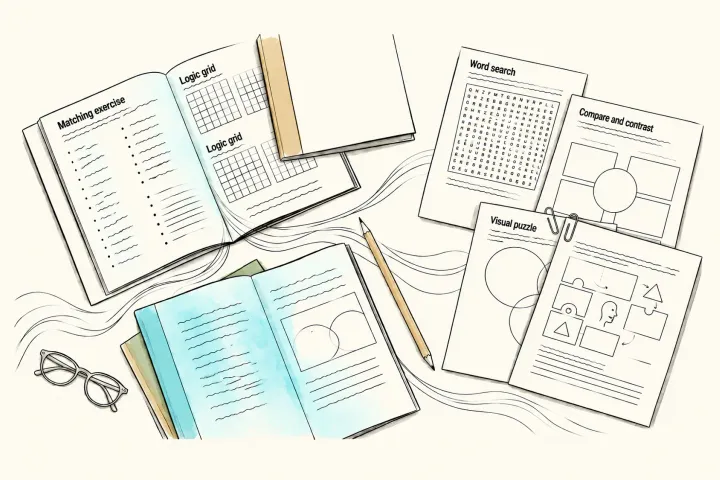
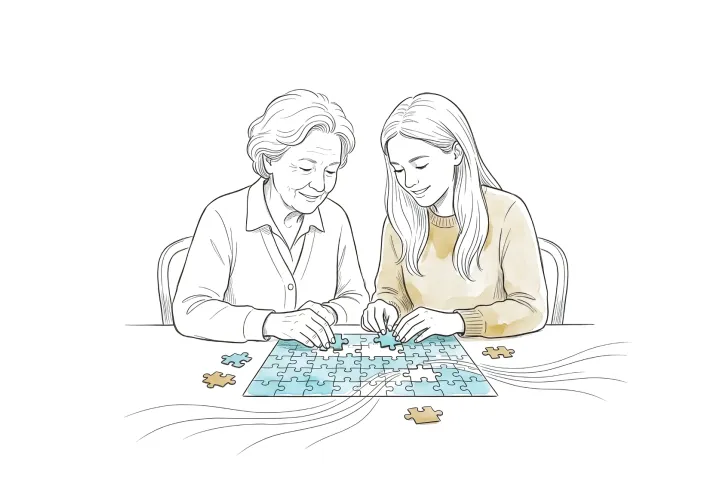
A large-print activity book you actually sit down and do with them. The point isn’t the book itself, or even the puzzles inside it — it’s the shared, active time it creates, sitting across the table with a pencil each, working through something together instead of at each other. It gives a visit an actual shape. I’ll admit we’re a little biased on this one, but the research on personalized, active engagement genuinely backs it up.
-
A subscription to something they’ll use weekly, not once a year. A favorite magazine, a coffee or tea subscription, a streaming service tied to a specific show you both watch and can talk about — pick something with enough frequency that it becomes a small, recurring point of contact, rather than a single unboxing moment that’s over in five minutes.
-
A day off from a specific chore, scheduled and shown up for. A vague “let me know if you need help with anything” rarely gets used — I’ve heard that offer go unclaimed more times than I can count, usually out of pride, sometimes out of not wanting to be a burden. Offering to handle yard work, a big grocery run, or an overdue home repair on a specific date turns a vague offer into something concrete they can actually plan around and look forward to.
-
A voice-recorded conversation, saved for the family. Sitting down with a parent and simply recording them talking about their life — a specific era, a specific person, a specific story you’ve always wanted the details on — tends to become one of the most treasured things a family ends up owning. Precisely because it can’t be bought any other way, no amount of money substitutes for it later.
-
A pair of long-distance connection lamps. These come as a matched set: when you touch or tap your lamp, theirs lights up at home, no matter how far apart you live. It’s a quiet, low-effort way to say “I’m thinking of you” on an ordinary Tuesday, without a phone call or a scheduled visit attached to it — just a small signal that shows up in the room.
-
A framed photo they haven’t seen in years, not a brand-new one. Dig into an old photograph instead of taking a new one — something specific, something with an actual memory attached to it, not a generic family portrait. The specificity of a photo tied to a real shared memory outperforms a nice new picture almost every time, in my experience and in what the research on personalized objects consistently finds.
-
A digital photo frame with remote upload. We’ll be honest: you will find this exact suggestion in nearly every gift guide for aging parents ever written, ours now included. There’s a reason it keeps showing up. Frames that let family members email or upload photos directly from anywhere mean your parent doesn’t have to touch a settings menu or sync anything — they just sit back and watch new pictures of the grandkids appear on their own. Sometimes the obvious pick earns its spot honestly.
-
A comfortable, well-made item for a room they actually spend time in. If you do go the physical-object route, aim for something used daily in a specific, known spot — a good cushion for the exact chair they already sit in every evening, a well-made throw for that same chair — rather than a decorative item that just competes for space on a shelf that’s already full.
-
A “no agenda” visit, planned and protected on the calendar. Sometimes the gift is simply blocking out real, unhurried time without errands attached to it, and then treating that time as genuinely non-negotiable, the same way you’d protect any other appointment you couldn’t reschedule.
-
A written letter, not a card. A card gets read once and set aside. A real letter — specific memories, specific gratitude, specific detail about what that person has meant to you — tends to get kept, reread, and sometimes even found again years later, tucked in a drawer. That’s really the definition of a gift that gets used.
The pattern worth remembering
Nearly everything on this list shares the same quality: it’s personal, it’s active, and it usually costs more of your time than your money. That’s not a coincidence — it’s exactly what the research on gift-giving and on aging both point toward, from two completely different directions that happen to land in the same place. If you’re looking for something to bring on your next visit that fits that pattern exactly, our Memory Games Collection and Memory Lane Collection are both built around shared, active time rather than one more thing to find room for — take a look at the collections here.